
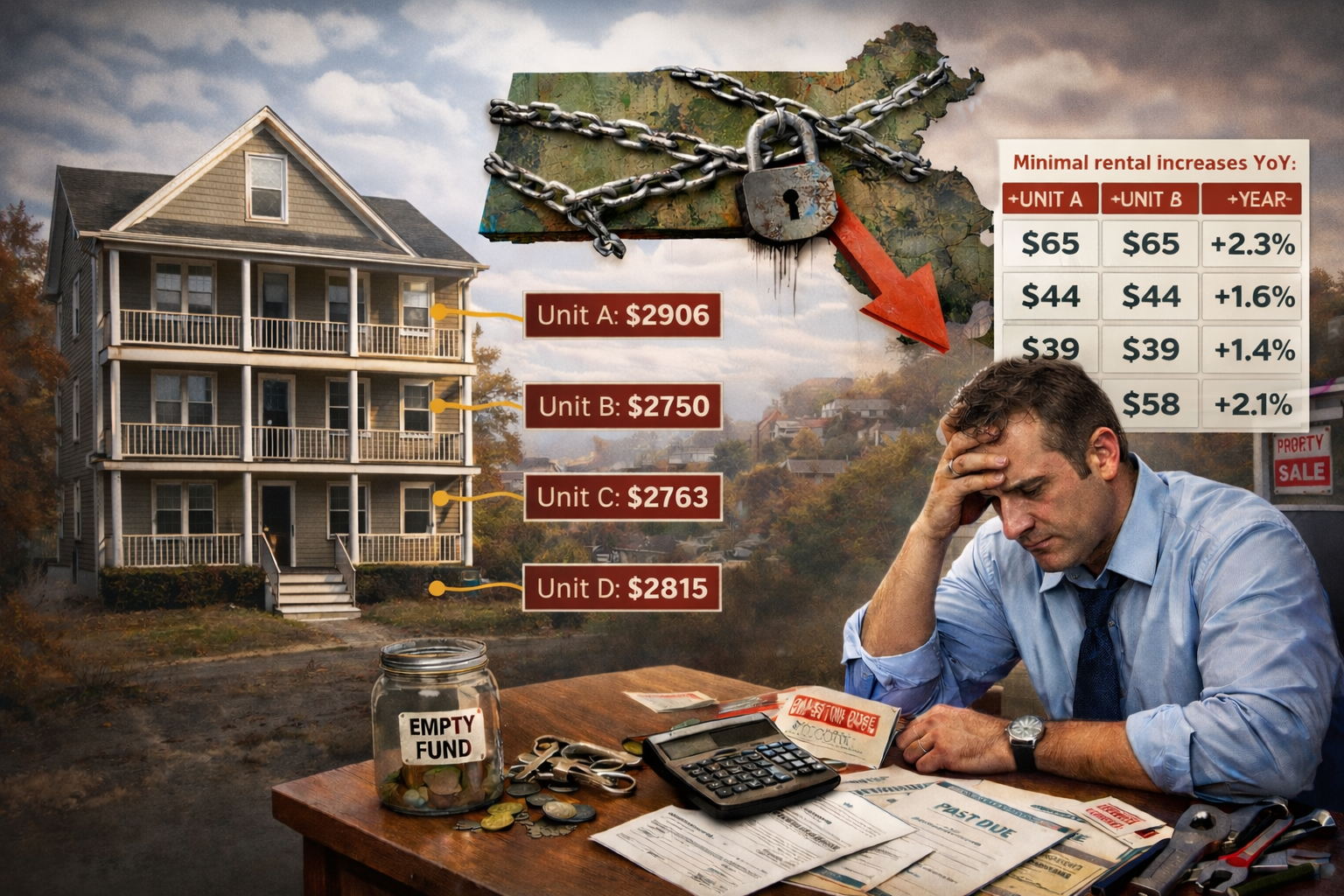
There’s a ballot initiative brewing in Massachusetts that would fundamentally reshape how rental housing operates across the Commonwealth.
At first glance, it sounds simple: cap rent increases at 5% or CPI (whichever is lower), apply it statewide, carve out a few exemptions, and call it a solution to affordability.
But if you’ve actually operated rental housing in New England, especially in older, cold-climate markets, you know it’s not that simple.
This week, I want to break this down from the trenches. Not from a policy desk. From the perspective of someone who manages buildings in Southern Maine, walks units, deals with deferred maintenance, and sits across from both tenants and owners, trying to make sense of it all.
The Intent: Where Rent Control Does Make Sense
Let’s start with the truth that often gets lost in these conversations:
Rent control exists because abusive landlord behavior exists.
There are absolutely cases, especially in high-demand markets, where rents spike beyond reason, tenants get displaced, and housing instability becomes real. Policies like this are born out of that reality.
And in isolated cases, rent caps can:
- Prevent extreme rent shocks
- Provide short-term stability for tenants
- Create political pressure to address housing supply
We're not blind to the fact that slum lords exist, and they take advantage of tenants to line their wallets.
For example, in Portland, Maine (a rent-controlled city), a recent enforcement case highlighted exactly why rent control exists - not as a theoretical policy, but as a response to real behavior in the market.
A group of tenants discovered that their landlord was circumventing rent control rules by adding additional charges for things like driveway use and shared spaces, effectively increasing rent beyond what the ordinance allows. At the same time, one unit reportedly jumped from roughly $1,100 to $2,650 per month, far exceeding permitted increases.
That part is real. And it deserves acknowledgment.
The Problem: Housing Doesn’t Operate in a Vacuum
Now let’s talk about what actually happens once rent control is implemented, especially at scale.
The Massachusetts proposal is not a “local option” model. It’s statewide - all 351 cities and towns.
That’s where things get serious.
Because once you cap revenue in a system where costs are not capped, you introduce a structural imbalance.
And that imbalance shows up in three places immediately:
1. Maintenance Gets Deferred (Whether Anyone Wants It or Not)
In New England, especially in older housing stock, maintenance isn’t optional; it’s constant.
We’re talking:
- Aging siding and paint (lead risk)
- Roofing systems nearing the end of life (leak potential)
- Boilers and heating systems are under winter stress (frozen pipes)
- Moisture intrusion, mold risk, and insulation deficiencies
When rent growth is capped artificially below cost inflation, owners don’t suddenly become negligent - they become constrained.
The result?
- Non-urgent repairs get delayed
- Capital improvement timelines stretch
- Preventive maintenance becomes reactive maintenance
And over time, that shows up in the condition of the housing itself.
2. Investment Behavior Changes (Quietly, Then All at Once)
One of the most overlooked impacts of rent control isn’t what happens inside a unit; it’s what happens in the decision-making of owners and investors.
If income potential is capped:
- Fewer buyers are willing to pay market prices for rental properties
- Property values soften (as already projected in studies tied to this ballot initiative)
- Owners reconsider reinvestment or expansion
We’ve already seen versions of this in Portland, Maine, since rent control was implemented locally.
Not overnight but gradually:
- Smaller operators pause acquisitions
- Larger operators shift capital to less-regulated markets
- New construction pipelines hesitate
Housing supply doesn’t just stop; it slows. And when supply slows in a demand-heavy region, affordability pressures don’t disappear. They compound.
3. Leasing Strategy Becomes Defensive
Here’s where it gets very real for property managers.
When rent growth is capped, leasing decisions change.
Owners start asking:
- “Is this tenant likely to stay long-term?”
- “Can I afford turnover under these restrictions?”
- “Should I prioritize stability over flexibility?”
And that can lead to:
- More conservative tenant screening (Fair Housing 101)
- Less willingness to take perceived risk
- Reduced mobility within the rental market
Ironically, a policy designed to increase housing access can tighten it.
The Data Point Everyone Should Pay Attention To
A study commissioned by the Greater Boston Real Estate Board in collaboration with Tufts University Center for State Policy Analysis projects:
- ~9% property value decline in Boston within 3 years
- Up to 27% declines in surrounding cities over a decade
- Significant municipal budget shortfalls tied to reduced tax bases
Whether you agree with the methodology or not, the direction of impact aligns with what we’ve seen historically, including Massachusetts pre-1994.
When property values decline, it doesn’t just affect owners.
It affects:
- Municipal services
- School funding
- Infrastructure investment
This is where housing policy becomes economic policy.
What This Means for Owners (Plain and Simple)
If you own rental property in New England - or are thinking about it - this is the lens you need to look through:
- Your upside becomes capped
- Your expenses remain uncapped
- Your operational margin tightens
- Your long-term strategy needs to adjust
That doesn’t mean “panic.” It means precision.
Owners will need to:
- Focus heavily on expense control
- Prioritize high-quality, durable improvements
- Think long-term hold vs. short-term gain
- Work closely with property managers who understand compliance and building performance
Final Thought: The Conversation We Actually Need
Rent control debates often get framed as:
Tenants vs. Landlords
That’s the wrong frame.
The real conversation should be:
How do we create more housing, maintain existing housing, and keep it safe and financially viable at the same time?
Because if you break any one of those three, the system doesn’t hold.
My Take (From the Field)
Rent control can solve a symptom, but it doesn’t solve the system.
And when implemented broadly, without addressing supply and cost realities, it tends to shift pressure rather than relieve it.
As someone who operates buildings, not just analyzes them:
The risk isn’t immediate collapse. The risk is slow degradation of assets, of supply, and of incentives.
And that’s much harder to reverse.
If you’re an owner or investor trying to navigate this - especially with exposure in Greater Portland, Maine - I’m always happy to talk through strategy.
Because this isn’t theoretical anymore.
It’s on the ballot in Massachusetts.
Additional media coverage of the study includes:
- Boston Globe: https://www.bostonglobe.com/
2026/03/12/business/rent- control-property-values- massachusetts/ - Commonwealth Beacon: https://commonwealthbeacon.
org/ballot-questions/rent- control-opponents-warn-of-300- billion-impact-to-local- budgets/ - WBUR: https://www.wbur.org/news/
2026/03/12/rent-control- ballot-initiative- affordability-housing - Boston Business Journal: https://www.bizjournals.com/
boston/news/2026/03/12/rent- control-could-cost-mass- billions.html
.webp)